


A greenfield BHS project at scale in South Asia
Hazrat Shahjalal International Airport in Dhaka plays a key role in Bangladesh’s international connectivity. As the country’s main international gateway, it connects South Asia with the Middle East, Southeast Asia, and other major travel routes.
The new terminal is one of the region’s important infrastructure investments and reflects Bangladesh’s growing role in aviation, trade, and international mobility. For an airport with this level of strategic importance, baggage handling is part of the operational foundation of the terminal.
Dimark was selected to deliver a complete baggage handling system for this greenfield project. The solution was designed for large-scale airport operations from day one, combining mechanical equipment, control systems, sortation, monitoring, and maintenance support into one integrated BHS ecosystem.
This project opens our Bangladesh case study series.
A new terminal designed for future airport operations
Greenfield airport projects create a unique opportunity. Instead of adapting baggage handling infrastructure to an existing terminal, the system can be planned as part of the new airport environment.
This matters because a Baggage Handling System influences much more than the route of a suitcase. It affects terminal capacity, operational flow, security processes, ground handling, maintenance planning, system visibility, and the passenger experience.
In Dhaka, the BHS was planned for a new terminal designed to support Bangladesh’s growing aviation demand. The system had to be ready for high volumes, complex operational scenarios, and long-term use in a demanding airport environment.
For Dimark, this meant delivering more than a set of devices. The project required a complete operational ecosystem, where baggage transport, sortation, monitoring, diagnostics, and maintenance tools work together.

Complete BHS delivery by Dimark
The scope of the project covered a complete baggage handling system for the new terminal. This included the physical infrastructure responsible for moving baggage through the airport, as well as the digital systems that support control, visibility, diagnostics, and maintenance.
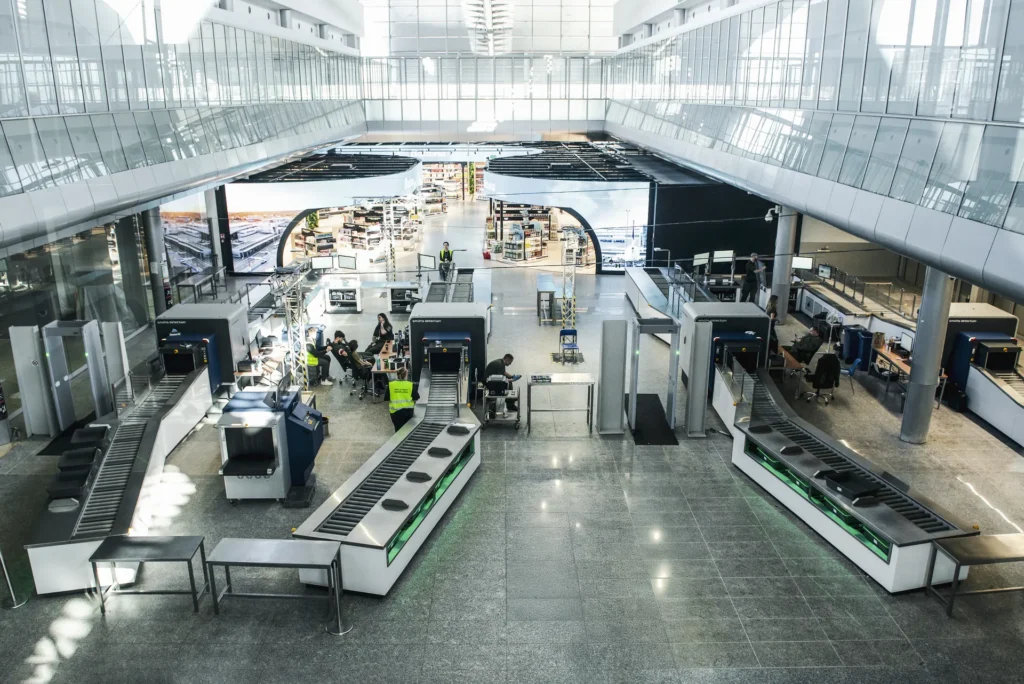
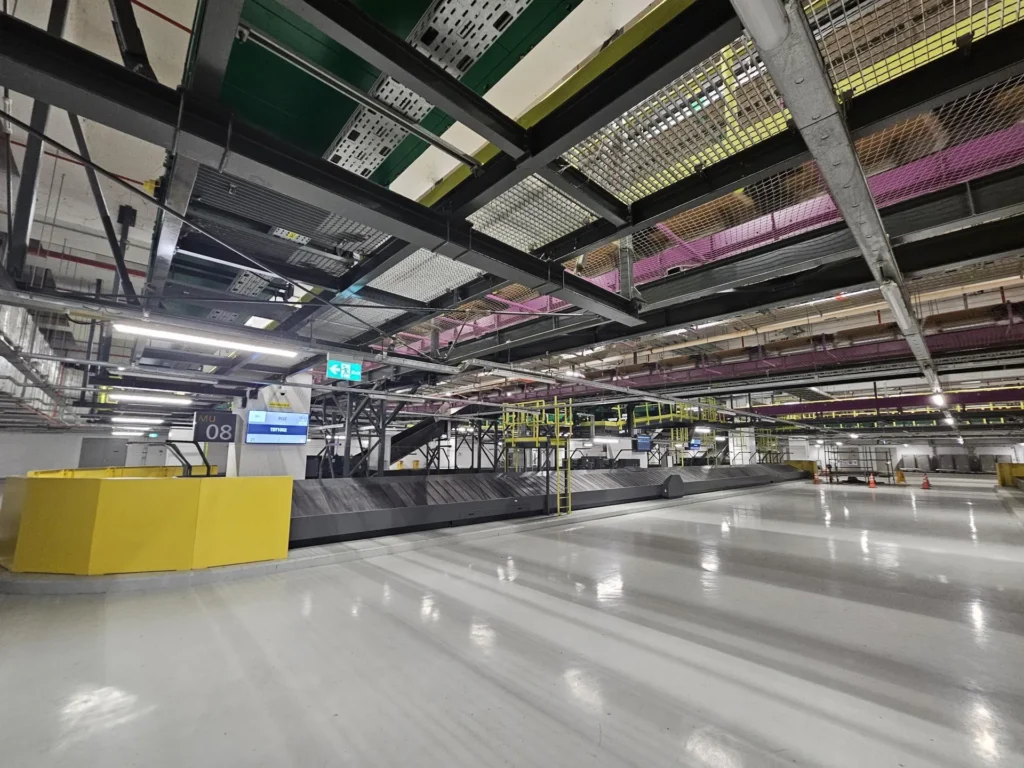
A large airport BHS has many layers. Conveyors move baggage between key areas of the terminal. Sorters direct bags toward the right destinations. Check-in areas feed the system. Carousels support departures and arrivals. Software provides visibility, control, and operational data.
In a project of this scale, each layer has to support the others. Mechanical equipment cannot be treated separately from automation. Monitoring cannot be separated from maintenance. Sortation cannot be separated from tracking and operational control.
This is why the Dhaka project was delivered as an integrated BHS ecosystem.

Sortation, monitoring and maintenance in one system
One of the key strengths of the Dhaka solution is the connection between high-capacity sortation, automated monitoring, and predictive maintenance.
High-capacity sortation supports the movement of baggage through the terminal and helps direct bags accurately within the system. Automated monitoring gives operational teams better visibility over what is happening across the BHS. Predictive maintenance tools support technical teams by helping identify potential issues before they affect operations.
Together, these elements support a more reliable airport baggage handling process.
For airport operations, this kind of integration brings practical value. Teams can see more, react faster, and manage the system with better information. Maintenance can be planned with more context. Diagnostics become clearer. Operational decisions are supported by data, not only by manual checks or delayed reports.
In a greenfield airport project, this approach is especially important because the system has to be ready for real traffic from the beginning. The first operational peaks are not the moment to discover weak points in visibility, diagnostics, or maintenance access.

Built for demanding operating conditions
The Bangladesh project was large, but also technically demanding.
The BHS had to operate in tropical environmental conditions, including extreme humidity. This required advanced anti-corrosion protection and careful engineering decisions to support long-term durability.
Projects of this type depend on disciplined planning and coordination. Design, production, installation, controls, site logistics, and commissioning have to move together. Any delay or mismatch between disciplines can affect the wider schedule.
Despite difficult global conditions during the project timeline, including supply chain disruptions, the system was installed and commissioned on schedule.
A strategic project for South Asian airport infrastructure
The completed system is one of the most advanced BHS installations in South Asia. It supports the new terminal with high-capacity baggage handling, integrated monitoring, maintenance visibility, and operational reliability.
For Bangladesh, the new terminal represents an important step in the modernization of national airport infrastructure. For Dimark, the project is a strong example of what greenfield BHS delivery means in practice.
It shows how airport baggage handling can be planned as a complete environment from the start: equipment, automation, software, monitoring, diagnostics, and maintenance support designed to work together.
This is what makes the Dhaka project an important part of Dimark’s international experience.

Long-term airport operations from day one
The real value of the greenfield project appears in daily operations, peak traffic, maintenance routines, service response, system visibility, and the ability to support future airport growth.
The Dhaka BHS was built with this long-term perspective. Its integrated ecosystem supports reliable baggage movement, full operational visibility, and maintenance processes prepared for continuous airport use.
For passengers, the result should feel simple: a bag is checked in, processed, sorted, loaded, and later collected. Behind that simple experience is a complete technical system designed to keep baggage moving through one of South Asia’s important new airport terminals.
This article opens our Bangladesh case study series. In the next publications, we will look closer at the scale of the system, the technical challenges behind the project, video-based baggage traceability, predictive maintenance, check-in areas, arrivals, and the sortation process.
Follow usGreenfield BHS for Dhaka Airport’s New Terminal
18 June 2026You Might Also Like

Check-in as the first stage of baggage handling
01 July 2026When passengers think about baggage handling, they usually imagine conveyors, sorters or reclaim carousels. In reality, every baggage journey starts much earlier. It begins at the check-in counter. At Hazrat Shahjalal International Airport’s new Terminal 3 in Dhaka, the baggage handling system delivered by Dimark includes 112 check-in counters. Together, they form the first operational […]

The ACI EUROPE Annual Congress & General Assembly in Prague brought together airport leaders and industry partners to discuss the future of European aviation, with topics including airport resilience, sustainability, digital transformation and long-term operational performance. One of the key moments of the event was the announcement of the ACI EUROPE Best Airport Awards 2026. […]

Factory Acceptance Testing (FAT) has been successfully completed for another stage of Dimark’s baggage handling system project for Riyadh Airports. As part of the process, representatives of the customer team visited Dimark to review, test and verify the equipment before shipment. The successful completion of FAT marks an important project milestone and confirms that the […]
Let’s continue the conversation, and shape the future of airport logistics together.