
Sustainability at Dimark

Engineering the future responsibly
Technology has value only when it creates a positive impact – for airports, passengers, our people and the environment. Sustainability and ESG principles are an integral part of every solution we design, build and deliver.
Our ESG approach is based on three areas

Product - sustainable engineering
Our systems are scalable, energy-efficient and environmentally conscious. We consider the full product lifecycle – from concept and production to operation and modernization.

Partnerships - responsible collaboration
We build open, ethical relationships with partners based on shared values, safety and accountability.

Team - people first
Innovation starts with people. Their safety, growth and well-being are always a priority.
Through ESG we create reliable and eco-friendly systems, support ethical supply chains and build safe and inclusive workplaces. This creates real business, operational and reputational value for our clients and partners.
Pillar I — Product
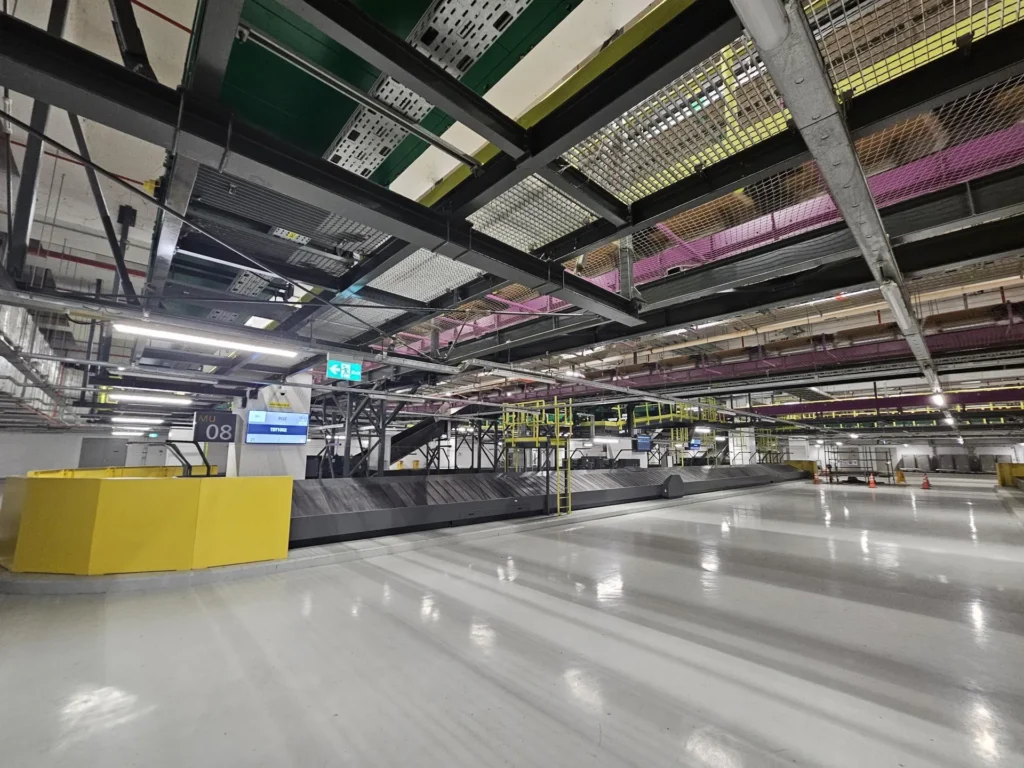
We develop scalable baggage handling solutions designed with climate neutrality, energy efficiency, and extended service life in mind. Sustainability is embedded throughout the product lifecycle — from design and manufacturing to installation and operation.
Sustainable Offer
Sustainable development is an integral part of every offer we prepare. We continuously assess and enhance our R&D initiatives to lower the energy consumption of our products and systems.
IE3 motors are installed as standard in client facilities, with the option to upgrade to higher-efficiency IE4 or IE5 models. These advanced motors deliver measurable energy savings, reduce greenhouse gas emissions, extend operational lifespan, and lower maintenance requirements.
Our systems also incorporate the wave concept: installed sensors ensure conveyors operate only when baggage is present, reducing energy consumption while maintaining full throughput.
Reducing Environmental Impact and Carbon Footprint
Energy efficiency and renewable energy adoption are key focus areas in our operations. We have implemented a Scope 1–3 energy and emissions monitoring system in accordance with the GHG Protocol and set a long-term goal of reducing emissions intensity by 30% by 2030.
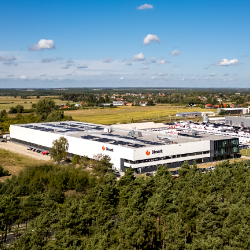
A major step in this direction is our new production facility in Golęczewo. The site provides more than 8,000 m² of optimized production space designed to streamline material flows. It is powered in part by a 250 kWp photovoltaic installation supported by battery storage, expected to cover nearly 80% of electricity demand during daytime operations. The building is heated using energy-efficient heat pumps.
We are also reshaping our production model to improve energy efficiency and reduce material consumption. One of the most significant technological upgrades is the shift from welding to mechanical clinching in sheet-metal joining.
Clinching delivers measurable benefits: 90% less waste, a 10% lower carbon footprint, 70% fewer welding gases, and an 80% reduction in processing time. As a result, our production processes are cleaner, more predictable, and substantially less carbon-intensive.
Sustainable Material Management
We continue to develop energy-efficient products while reducing material losses and embedding circular solutions into Dimark systems. Packaging for transport to assembly sites is continuously optimized in cooperation with partners to minimize environmental impact.
Pillar II — Partnerships
We believe sustainable impact requires responsible collaboration. Our partnerships around the world are built on shared values, safety standards, and product responsibility.
Responsible and Ethical Cooperation
Our objective is clear: 100% of strategic suppliers compliant with the DIMARK Code in the areas of health and safety, ethics, labor law, and environmental protection.
We extend the same requirement to our operational partners: 100% of business partners comply with the DIMARK Code, including those operating at assembly sites.
Our objective is full compliance of strategic suppliers and business partners with the DIMARK Code in the areas of health and safety, ethics, labor law, and environmental protection. ESG provisions — including human rights, labor rights, health and safety, and environmental protection — have been formally integrated into our contract templates.
Transparent and ethical organization
Internally and across our value chain, we promote high ethical standards through a structured governance framework. We have implemented a Code of Ethics and a dedicated whistleblowing system. All employees are trained in ethics, anti-corruption, and reporting procedures. Our Code of Conduct, structured training initiatives, and Ethics Committee ensure compliance while strengthening a culture of integrity and accountability. Employees are encouraged to raise concerns through a secure online platform.
Pillar III — Team
We are committed to creating a work environment where safety, professional development, and employee well-being — including on assembly lines — are priorities.
Employee Safety
We prioritize the health and safety of our employees and strive for zero accidents involving Dimark employees and associates. KAIZEN principles are implemented to continuously improve operational and safety standards.
We continue the “Safety Days” initiative to promote awareness and education. Additionally, we have introduced LTIR (Lost Time Injury Rate) and near-miss monitoring, with quarterly analysis of results and structured preventive and corrective measures.
Employee Development
We support long-term employee growth through our suggestion and innovation program and structured apprenticeship partnerships with Poznań University of Technology and the Electrical Technical School in Tarnowo Podgórne. Each year, we welcome new apprentices as part of our development pathway.
In the near future, we plan to strengthen employee engagement by implementing employee engagement study, followed by a systematic development framework, introducing a structured goal setting and performance evaluation system. Our goal is also to keep the turnover rate below 10%.
Certifications Supporting Our Sustainability Framework
Our sustainability framework is supported by internationally recognized management system certifications that provide structure, accountability, and continuous improvement across our operations. These standards ensure that our environmental, social, and governance commitments are embedded in day-to-day management practices and regularly verified through independent audits.
ISO 9001 confirms that our quality management system meets global standards for process control, reliability, and customer satisfaction. It supports consistent performance across the full lifecycle of our baggage handling solutions — from design and manufacturing to installation and service — and reinforces our commitment to operational excellence.
ISO 14001 certifies our environmental management system and provides a structured approach to identifying, monitoring, and reducing environmental impact. It strengthens our efforts in resource efficiency, emissions management, and environmental risk control, directly supporting our target to reduce emissions intensity by 30% by 2030.
ISO 45001 reflects our systematic approach to occupational health and safety. It ensures structured risk identification, preventive measures, and continuous safety performance improvement, reinforcing our objective of zero accidents involving Dimark employees and associates.
ISO 27001 certifies our information security management system, ensuring the protection of sensitive data, intellectual property, and operational continuity. It strengthens cybersecurity, risk management, and stakeholder trust across our global operations.
Together, these certifications provide a verified and integrated management foundation that supports the long-term credibility and effectiveness of our sustainability strategy.
Policies
- Dimark’s Code of Conduct
- Code of Conduct for Business Partners
- ISO Certificates